
Managed IT Services
AI Readiness in Healthcare: The First Step Toward Smarter, Safer, More Personalised Care

A Sector on the Edge of Transformation
There’s a period of growing pains running through the Australian healthcare sector currently as it undergoes an overhaul of record-keeping and process automation. And doing so under strict regulation and tight controls, given the real-world implications that an error can lead to. This new era of digital transformation in healthcare and ushering in the use of AI is changing the way care is delivered, from diagnostics and administration to patient engagement and disease prevention. Yet for most organisations, AI readiness is not just about adopting new technologies. It is about ensuring better patient outcomes, supporting clinical teams, and maintaining compliance with privacy and safety standards.
Before implementing AI-driven tools or automation, healthcare leaders need to understand where their organisation stands in terms of readiness. Building a foundation for AI maturity ensures that technology enhances, rather than disrupts, the quality of care and clinical trust.
The Key Statistics For AI Readiness in Australia
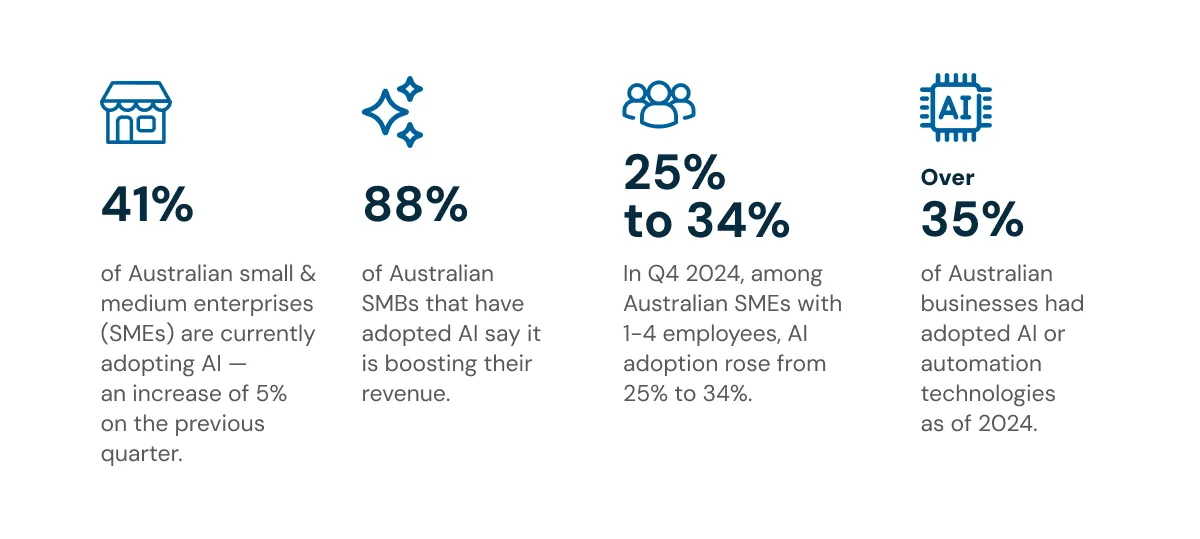
Source: Local digital
What Is AI Readiness in Healthcare?
AI readiness in healthcare refers to an organisation’s ability to safely and effectively adopt, integrate, and scale artificial intelligence solutions. It assesses infrastructure, workforce capability, governance, data management, and leadership strategy. A well-prepared organisation can use AI to deliver predictive, preventative, and personalised care while ensuring patient safety and regulatory compliance.
Research published by the Digital Medicine Society (DiMe) and BMC Health Services Research highlights that most health systems are still in the early stages of AI maturity. Readiness depends on multiple domains, including leadership, data quality, ethics, and workforce development. In short, AI readiness is about creating an environment where innovation can improve patient care without compromising privacy, security, or compliance.

The 5 Stages of AI Readiness: From Pilots to Precision Care
Healthcare organisations progress through distinct stages as they move toward full AI maturity. Each stage builds upon the last to create a safer and more sustainable integration of AI into healthcare environments.
1. Foundational (Awareness)
Organisations understand the potential of AI but have no clear strategy or infrastructure. Systems are often fragmented, and data is unstructured.
2. Emerging (Pilots)
Early pilots may focus on administrative or triage functions. While useful, these initiatives are not yet integrated across the wider organisation
3. Maturing (Defined Use)
AI tools are deployed in select areas where they are already improving outcomes, such as scheduling or patient communication. Measurable results begin to inform leadership decisions.
4. Strategic (Embedded Use)
AI is integrated into multiple clinical and operational workflows. Governance and risk management frameworks are in place, and the workforce is trained and engaged.
5. Transformational (Precision Care)
AI is fully integrated across systems and care pathways, enabling predictive and personalised care at scale. Data flows seamlessly across platforms, supporting proactive healthcare models.
Understanding these stages helps healthcare providers determine their current position and identify the necessary steps to move forward. AI maturity is not an adoption race, but a measured journey toward safer, evidence-based care.

Turning Insights Into Impact
Becoming AI-ready means converting readiness assessments into actionable change. To achieve this, healthcare organisations should focus on five key areas:
1. Build secure, interoperable data systems
Patient data must be structured, accessible, and compliant with Australian privacy laws such as the Privacy Act 1988 and the Australian Digital Health Agency standards. Interoperability across clinical and administrative systems allows AI to generate meaningful insights without compromising patient confidentiality.
2. Embed governance, ethics, and risk frameworks
Responsible AI requires oversight. Organisations need frameworks to ensure fairness, transparency, explainability, and traceability. These principles, highlighted in international guidelines such as the FUTURE-AI Consortium, are essential to maintaining trust and safety in AI-driven healthcare.
3. Pilot solutions before scaling
Small-scale pilots help teams measure impact, refine workflows, and establish value before expanding. Successful examples include predictive analytics for patient flow, workforce scheduling, and administrative automation.
4. Empower and train the workforce
A workforce confident in using AI is critical. Clinicians and administrative staff must understand how AI supports decision-making, rather than replacing it. Training programs and clear communication about AI’s role build trust and adoption across the organisation.
5. Align leadership and strategy
AI readiness begins with leadership. Executives and boards must align AI initiatives with organisational goals such as patient safety, efficiency, and improved outcomes. Strategic oversight ensures long-term success rather than short-term experimentation.
Readiness becomes meaningful only when insights are turned into measurable outcomes that improve patient care, workforce performance, and operational resilience.

Assessing Your AI Readiness
Determining AI readiness starts with asking the right questions. A comprehensive assessment should cover data management, workforce capability, compliance, governance, and leadership strategy. Consider the following checklist:
- Is your clinical and administrative data structured, compliant, and accessible for AI applications?
- Are staff trained and comfortable using AI tools in their daily workflows?
- Do you have governance frameworks that meet Australian healthcare regulations?
- Has your leadership developed a strategy aligning AI initiatives with patient and operational goals?
- Are existing pilot programs delivering measurable improvements that can be scaled safely?
Structured readiness assessments, such as those published by DiMe and other international frameworks, help healthcare leaders identify capability gaps and prioritise investments. This approach ensures AI implementation aligns with both clinical safety and long-term sustainability.
Conclusion: AI Readiness as a Strategic Healthcare Priority
AI readiness is no longer optional for healthcare providers in Australia. It is a strategic priority that determines how safely and effectively organisations can adopt technologies that enhance patient care. By focusing on secure data systems, strong governance, skilled staff, and strategic alignment, healthcare leaders can move from isolated AI pilots to system-wide transformation.
Assessing readiness is not just the first step toward AI adoption, it is the foundation for more innovative, safer, and more personalised care that supports clinicians, protects patients, and strengthens trust.
DJC Systems Helps Keep Healthcare on Track and Personalised
If your healthcare organisation is ready to take the next step toward AI readiness, DJC Systems can help. As experienced IT partners to medical practices and healthcare networks across Australia, DJC Systems provides secure infrastructure, reliable connectivity, and proactive compliance management that form the foundation for AI success.
Book your consultation today with a healthcare IT specialist to begin your AI readiness assessment and prepare your healthcare organisation for a brighter and more connected future.